From authoritative to survival mode, our parenting style quiz reveals everything about how you interact with your child!

 By: Tali Ditye, Ph.D., Co-founder
Mommyhood101 independently tests and curates baby gear to help you make informed decisions. If you buy products through links on our site, we may earn a commission.
Our quiz combines both science and real-world scenarios to give you a fun estimate of your parenting style.
Answer the questions below and see your instant, free results!


When you're done, see our reviews of the best baby products of the year for your growing family.
Take the Parenting Style Quiz!
Where "Parenting Style" Comes From
The modern idea of parenting styles traces back to developmental psychologist Diana Baumrind, who described broad patterns in how parents balance warmth, responsiveness, and expectations.
Later work expanded this framework, often described as combinations of two dimensions:
- responsiveness (warmth, attunement)
- demandingness (limits, guidance, expectations) (Baumrind, 1960s–1970s; Maccoby & Martin, 1983)
Many research summaries describe authoritative parenting (high warmth plus clear expectations) as a consistently positive pattern in studies of child and adolescent outcomes, while emphasizing that family context, culture, and child temperament all matter (Kuppens & Ceulemans, 2019).
What Our Parenting Style Quiz Measures
Our quiz distinguishes five friendly "styles" that parents commonly recognize in real life:
 Gentle: empathy-forward, connection-based responses.
 Authoritative: warm, steady leadership with boundaries and follow-through.
 Laid-Back: flexible, low-stress, picks battles carefully.
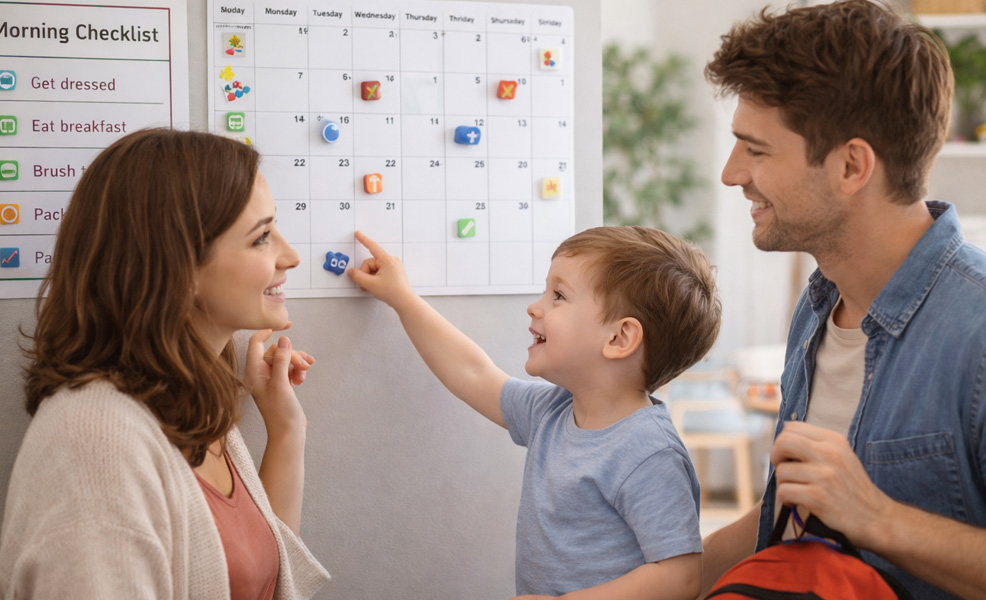 Structured: routine-driven, clear rules, predictable expectations.
 Survival Mode: a season of high demand/low bandwidth, makes for practical, get-through-the-day parenting.
These are not clinical categories. They’re real parent language that generally maps onto established research concepts. Your results are best used as a conversation starter!
Blends of Parenting Style, and Radar Charts
In practice, most parenting styles don’t fit perfectly into a single box.
That’s why your results include a radar chart showing your "blend" across parenting styles. A higher point on a style simply means you chose more answers aligned with that approach.
It’s normal to see a mix; in fact, many families use one style at bedtime, another during conflict, and another when life gets hectic!
Research on parenting repeatedly finds that patterns of parenting matter more than any single moment.
If you’re in Survival Mode, that doesn’t mean you’re failing. Instead, it often means you’re navigating a high-load time period and using the tools you have.
What the Parenting Style Research Generally Suggests
Across many studies, authoritative approaches (warmth + structure) have been linked with outcomes like academic achievement and psychosocial maturity in adolescence (Steinberg et al., 1989; Lamborn et al., 1992).
Other work and meta-analytic evidence has linked authoritative parenting with prosocial behavior in children (Wong et al., 2021). More recent studies continue to explore how parenting styles relate to cognitive and self-regulatory skills (Sadeghi et al., 2022).
Importantly, these are group-level patterns, they are not guarantees for an individual child. Your child’s temperament, developmental stage, neurodiversity, and your family’s culture and support system all shape what works best!
Try the Quiz, Then Use the Results Well
- Read your top style and note what resonates.
- Look at your blend, your second-highest style is often just as informative.
- Pick one small experiment for the week (e.g., a clearer boundary, a calmer repair, a simpler routine).
- Be kind to yourself. Parenting is a long game, and you’re allowed to learn as you go.
Frequently Asked Questions
What is a parenting style quiz?
A parenting style quiz is a reflective tool designed to help parents understand common patterns in how they respond to their children, such as balancing empathy, structure, flexibility, and rules. It is not a diagnostic test, but a way to spark insight and self-awareness.
How accurate is this parenting style quiz?
This parenting style quiz is meant to be informative and reflective rather than clinically diagnostic. It is based on well-established parenting concepts from developmental psychology, but individual results should be interpreted as a general guide, not a definitive label.
What parenting styles does the quiz measure?
The quiz looks at five common parenting styles: gentle, authoritative, laid-back, structured, and survival mode. Most parents show a blend of these styles rather than fitting perfectly into just one.
Why do I get a radar chart with my results?
The radar chart shows how strongly you lean toward each parenting style based on your answers. It highlights that parenting is usually a mix of approaches and that flexibility across situations is normal and healthy.
Is there a best or healthiest parenting style?
Research often links authoritative parenting—combining warmth with clear expectations—to positive child outcomes, but no single style works best for every family. Child temperament, age, culture, and life circumstances all play important roles.
Does being in “survival mode” mean I am a bad parent?
No. Survival mode reflects a season of high stress, limited resources, or major life demands. Many parents experience this at times, and it does not reflect parenting ability or long-term outcomes.
Can my parenting style change over time?
Yes. Parenting styles often shift as children grow, family circumstances change, or parents gain new tools and support. Your quiz results reflect your current tendencies, not a permanent trait.
References
- Kuppens, S., & Ceulemans, E. (2019). Parenting Styles: A Closer Look at a Well-Known Concept. PMC
- Steinberg, L. (1989). Authoritative Parenting, Psychosocial Maturity, and Academic Success among Adolescents. PubMed
- Steinberg, L., Lamborn, S. D., Dornbusch, S. M., & Darling, N. (1992). Impact of parenting practices on adolescent achievement: Authoritative parenting, school involvement, and encouragement to succeed. Child development, 63(5), 1266-1281.PubMed record
- Wong, T. K. Y., et al. (2021). Parenting and prosocial behaviors: A meta-analysis. Wiley
- Sadeghi, S., et al. (2022). Parenting Styles Predict Future-Oriented Cognition in Children. PMC